
You've probably lived this already. An analyst opens the console at the start of a shift and sees a wall of alerts, many of them familiar noise, while the one attack that matters is quiet, blended in with ordinary logins, service activity, and automation. AI threat detection matters because that gap, between what humans can triage and what attackers can hide inside, has become the primary operational problem.
At the same time, the economics are hard to ignore. Independent analysis of IBM's breach-cost reporting found that organizations using AI and automation extensively detected breaches faster and contained incidents sooner, while also saving money per breach compared with more limited automation (Toolix Lab summary of IBM 2025 data). IBM's earlier 2024 data, summarized separately, showed the same pattern in cost terms, with $3.84 million average breach costs for organizations with extensive AI and automation in security versus $5.72 million for organizations with none (Stealth Agents summary of IBM 2024 data). The point isn't that a model replaces a SOC. It's that the SOC now needs a detection layer that learns, correlates, and adapts.
Table of Contents
- Why AI Threat Detection Matters Now
- Threat Categories and the ML Approaches That Catch Them
- Inside the Detection Pipeline and Training Data
- Evaluation Metrics and Datasets That Actually Predict Performance
- Deployment Patterns and How Donely Fits the Stack
- The Gaps Most Guides Skip, Including AI Agents as a Threat Surface
- Implementation Checklist and Sample Detection Agent Blueprint
- Bringing It Together and What to Do This Quarter
Why AI Threat Detection Matters Now
A lot of SOC leads are still trying to win a game that attackers stopped playing years ago. Signatures are fine for known threats, but the challenge emerges in the gray area: a fileless script, a legitimate admin tool used the wrong way, or a slow credential abuse chain that never looks loud enough to trip a rule. AI threat detection steps into that gap by looking for behavior, context, and relationships instead of waiting for a perfect match.
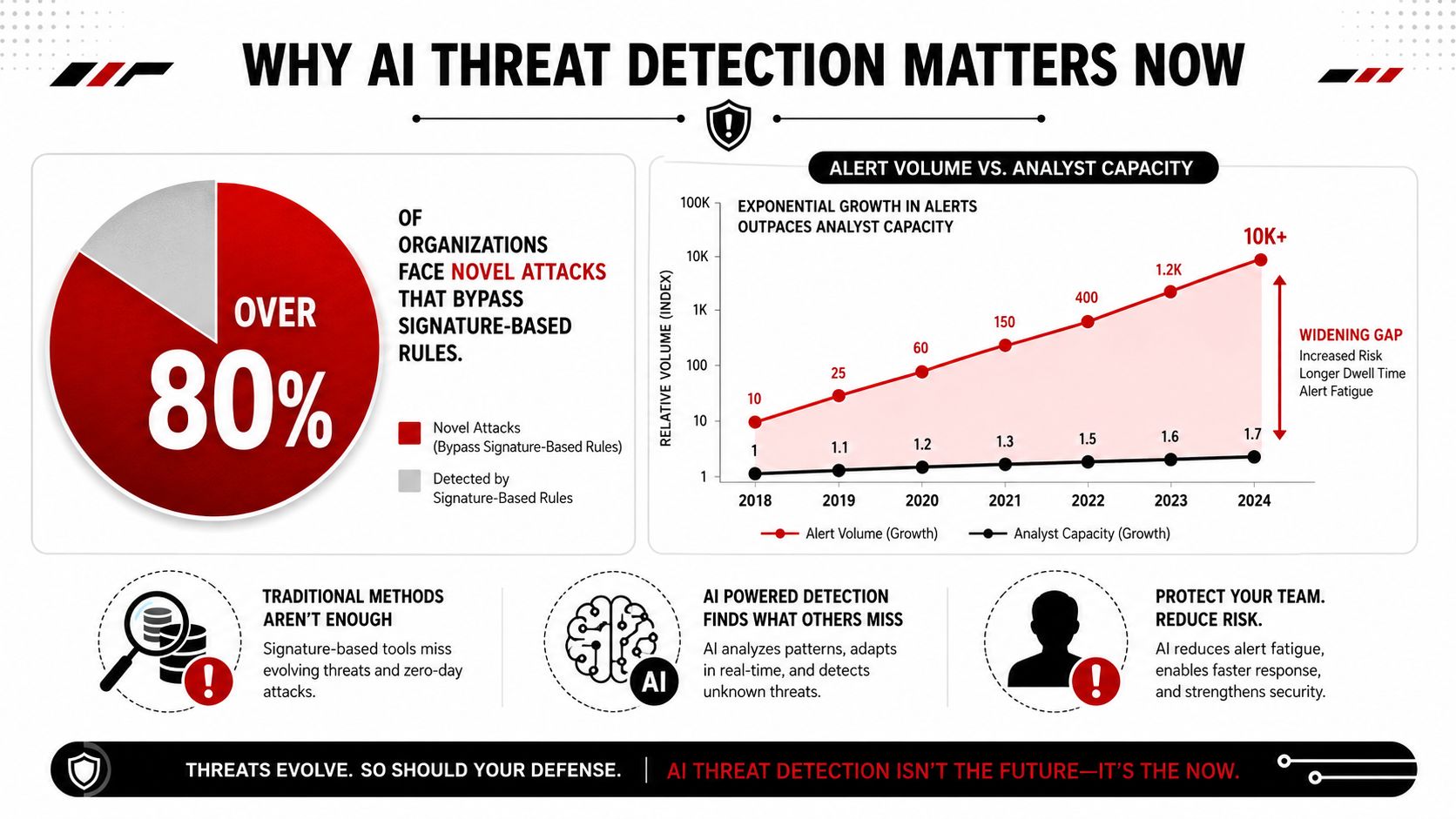
Why the alert queue keeps growing
The daily pain point isn't a lack of alerts, it's that the queue keeps accumulating faster than people can review it. That's why teams start looking for outside context, including dark-web exposure and leak monitoring, before attackers turn a weak signal into a full incident. A practical place to start is InsecureWeb dark web monitoring, especially when your team needs another source of identity and exposure signals without adding more manual searching.
The other reason this matters now is that detection has become a layered system, not a single rule. Microsoft describes a workable pipeline that turns unstructured threat reports into structured detection insights by extracting TTPs, normalizing them to a schema such as MITRE ATT&CK, and then analyzing coverage gaps against the existing detection catalog (Microsoft Security blog). That workflow is useful because it turns narrative intelligence into engineering tasks your SOC can prioritize.
Practical rule: if a detection can't be explained as telemetry, context, and response action, it's probably too vague to trust in production.
The last shift is uncomfortable but important. AI detections now have to keep up with environmental drift, and they also have to watch identity abuse that doesn't fit the old “user with a laptop” model. That includes service accounts, API keys, and AI agents that can look normal until they don't.
Threat Categories and the ML Approaches That Catch Them
Start with the threat, then choose the model. That order saves a lot of confusion, because not every security problem needs the same kind of intelligence. A supervised classifier is closer to a checklist, while an anomaly detector behaves more like a tripwire that fires when the room looks different than usual.
Match the model to the attack pattern
Known malware families and familiar phishing patterns usually fit supervised classification well, because you already have examples to learn from. Unknown activity, including suspicious lateral movement or a never-before-seen sequence of events, is usually better suited to anomaly detection, which compares current behavior to a learned baseline. Behavioral analytics fits insider risk and credential abuse because the question isn't “does this event look malicious by itself,” it's “does this person or identity usually behave like this?”
Streaming detection matters when the event rate is too high for batch review. In that setting, the model has to score a continuous flow of logs and return a risk signal quickly enough for the SOC to act. That's why AI threat detection is usually a blend of techniques, not a single algorithm.
Here's a simple map you can keep in your head:
- Known malware or repeated attack families: supervised models, because they learn from labeled examples.
- Unknown or novel activity: anomaly detection, because it watches for deviation from normal.
- Insider risk and credential misuse: behavioral analytics, because context over time matters.
- High-volume event streams: streaming models, because the decision has to happen while the data is still moving.
For adjacent problems like financial fraud, the pattern is similar. Fraud detection with AI uses the same basic logic, unusual behavior in a noisy stream, then correlates it with context before escalating. Security teams can borrow that mental model without pretending finance and cyber are identical.
A useful way to explain this to analysts is simple. A signature is a locked door with a known key shape. AI is the person checking whether the key, the motion, and the timing all make sense together.
Inside the Detection Pipeline and Training Data
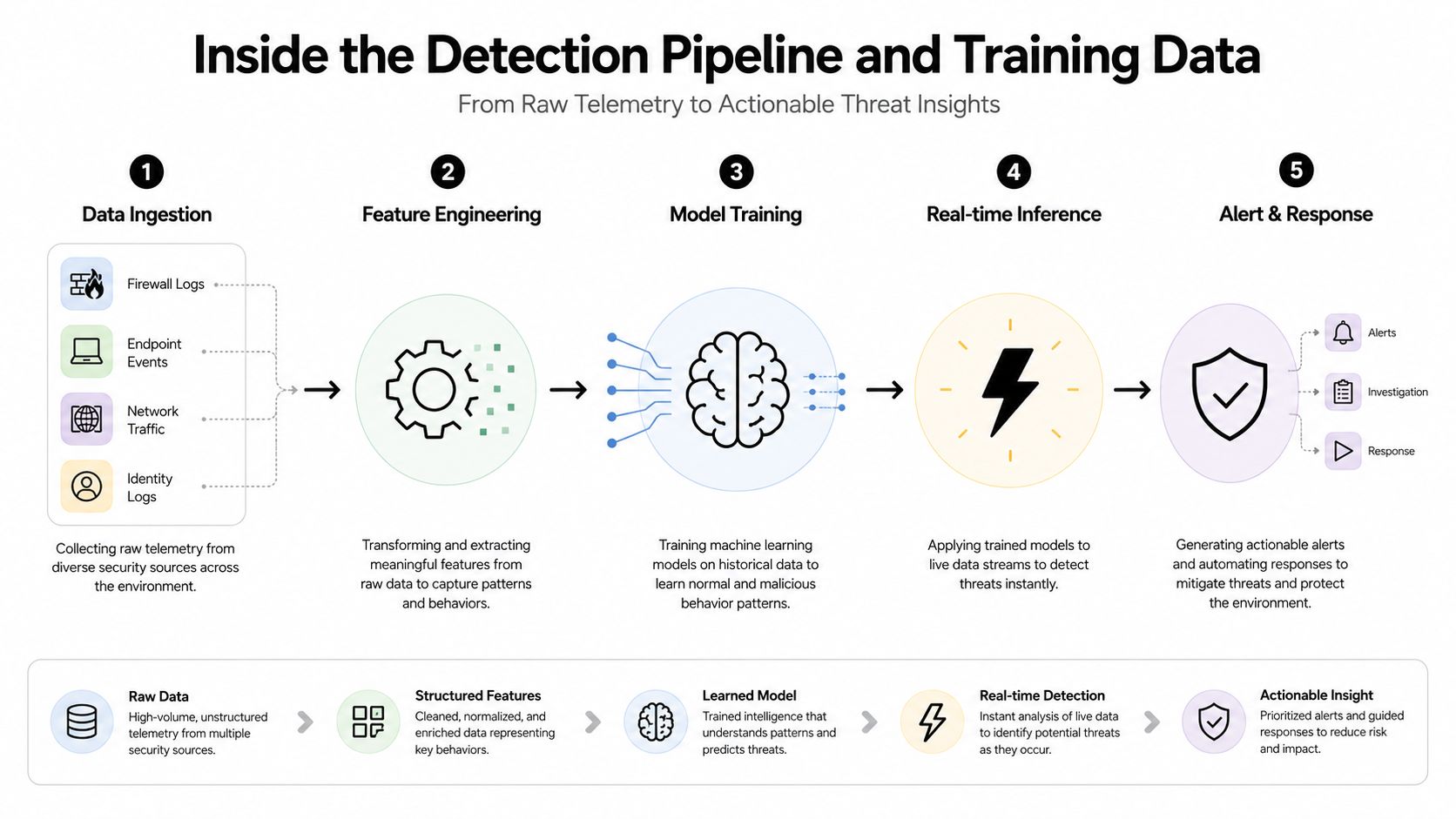
A detection model is only as useful as the pipeline behind it. If telemetry enters the system in poor shape, the model will not repair that later. Solid AI threat detection usually starts with telemetry ingestion, then preprocessing and feature engineering, then training or scoring against a model that returns a risk level or class label.
From raw logs to useful signals
The telemetry layer needs enough breadth to show behavior across systems. Palo Alto Networks lists firewall logs, endpoint events, network traffic, system alerts, and threat-intelligence feeds as the kinds of inputs that give a model enough context to separate benign activity from exfiltration, credential abuse, or lateral movement (Palo Alto Networks Cyberpedia). In practice, that means you are not just collecting “security logs.” You are bringing in identity activity, process execution, network chatter, and outside signals that help explain what changed.
Feature engineering turns that raw stream into model input. Login frequency, device location, file-access attempts, and IP reputation are common signals because they convert messy logs into measurable behavior. If a user signs in from a new region, touches a sensitive share, and then reaches for unusual endpoints, the model has a pattern to evaluate instead of three disconnected facts.
Normalization is easy to skip and hard to replace later. A sound pipeline maps incidents and reports into a standard schema such as MITRE ATT&CK, so the security team can compare like with like and measure coverage gaps in a consistent way. That kind of structure matters because threat intelligence only becomes operational after it is organized into something the SOC can tune and test, as described in Microsoft Security blog. If the same event can be labeled three different ways, the model and the analysts both lose clarity.
A model trained on partial telemetry tends to become confident in the wrong things.
A lateral movement example
Take suspicious lateral movement. The first clue might be an endpoint event showing a remote service start, followed by identity logs that show an unusual account path, then network telemetry that reveals a new internal connection pattern. The model does not need to understand the whole attack the way a human would. It needs enough context to say that this combination deviates from baseline and deserves review.
The hard truth is that telemetry gaps create blind spots. If your environment does not see the event, the model cannot score it. That is why log coverage and data quality belong to detection engineering, not a separate housekeeping task.
For a related perspective on how machines interpret evidence streams, see analyze digital video evidence from AI Video Detector, which uses a similar idea of turning noisy inputs into structured judgments.
Donely's company brain can serve as a reference point for how a structured agent layer is organized, but the detection logic still depends on the telemetry you feed it. That matters when you are deciding how to operationalize detections through an orchestration layer instead of leaving every alert to a manual handoff.
Evaluation Metrics and Datasets That Actually Predict Performance
A model can look great in a notebook and still be painful in a SOC. That's because security teams feel the cost of every mistake directly, in pages, interruptions, missed alerts, and analyst trust. The right question isn't whether a model is clever, it's whether it behaves in a way your team can live with.
What the core metrics really mean
Precision tells you how many alerts are useful. Recall tells you how much of the badness the model catches. F1 balances the two, which is useful when you don't want to optimize one at the expense of the other.
False positive rate matters because a noisy detector burns analyst attention fast. Detection latency matters because a slow detector can still be technically correct and operationally late. A model that pages constantly on harmless activity is worse than a slightly less sensitive model that produces a small number of credible leads.
| Metric | What it measures | Operational cost when low | Operational cost when high |
|---|---|---|---|
| Precision | Share of alerts that are real | Analysts waste time reviewing noise | Some real threats may be missed if the model is too conservative |
| Recall | Share of threats the model catches | More misses, more exposure | More alerts, more triage load |
| F1 | Balance between precision and recall | Poor overall detection balance | Better trade-off, but still needs tuning for operations |
| False positive rate | How often benign activity is flagged | Fewer interruptions, but watch for blind spots | Alert fatigue and lower analyst trust |
| Detection latency | Time from event to alert | Slower containment and longer dwell time | Faster response, but only if the alert remains actionable |
The dataset question is just as important. Public corpora are useful for experimenting, but they rarely reflect the exact shape of your environment. A held-out test set can still miss production drift, seasonal behavior changes, cloud migrations, and the weirdness of real identity patterns. If you're evaluating a vendor or an internal model, ask whether the data looks like your own logs, your own users, and your own attack surface.
What good evaluation looks like
A serious evaluation includes benign baseline data, labeled attack examples, and time-based testing that reflects how the model will age. It also checks how the detector behaves when the environment changes, because a stable lab dataset can hide operational fragility.
If a detection only works on clean historical data, it's a lab result, not a security control.
That's the mindset shift. You're not buying a score, you're buying confidence under change.
Deployment Patterns and How Donely Fits the Stack
Models don't live alone. In production, they usually show up as an embedded API, a sidecar scoring service, a streaming consumer, or a managed agent that sits between telemetry and response. The architecture choice depends on where you want the decision to happen and how much control your team needs over updates, routing, and auditability.
Common ways teams ship detection
An embedded API works when another platform already owns the workflow and only needs a score. A sidecar service fits teams that want scoring next to the data source without tightly coupling everything into one app. Streaming platforms are better when the detector has to keep up with constant telemetry and make near-real-time decisions.
The orchestration layer is where many teams get stuck. That's the part that handles enrichment, routing, escalation, audit logs, and integration sprawl. Donely fits there as one option, because it lets teams host and manage AI employees from a single dashboard, use built-in integrations across tools like Gmail, Slack, Jira, Zendesk, Salesforce, HubSpot, Stripe, and more, and connect workflows to channels such as WhatsApp, Telegram, Discord, and Slack. Its integration library is documented at Donely integrations.
Why orchestration matters for detection workflows
A detection agent usually needs more than a score. It needs identity context, asset context, a place to send high-confidence cases, and a queue for the messy ones. Donely's blueprint model is relevant here because it lets a team package the workflow once, then reuse it across instances without rebuilding the same logic for every client or business unit.
That matters when isolation is part of the requirement. Multi-instance separation keeps personal, business, and client workloads apart, while per-instance RBAC, isolated containers, scoped data access, and unified audit logs give operators a cleaner boundary for permissions and review. If you're trying to run detection workflows across multiple environments, the structure matters as much as the model.
A practical deployment question is whether the platform keeps the agent layer observable. If you can't trace what it enriched, what it scored, and what it escalated, you don't really have a detection system, you have a black box with a ticket queue.
The Gaps Most Guides Skip, Including AI Agents as a Threat Surface
The biggest mistake in most AI threat detection writeups is treating the environment as static. It isn't. New SaaS apps get added, cloud migrations change identity paths, seasonal usage patterns shift baselines, and the detector that looked sharp last quarter starts to drift into noise or silence.
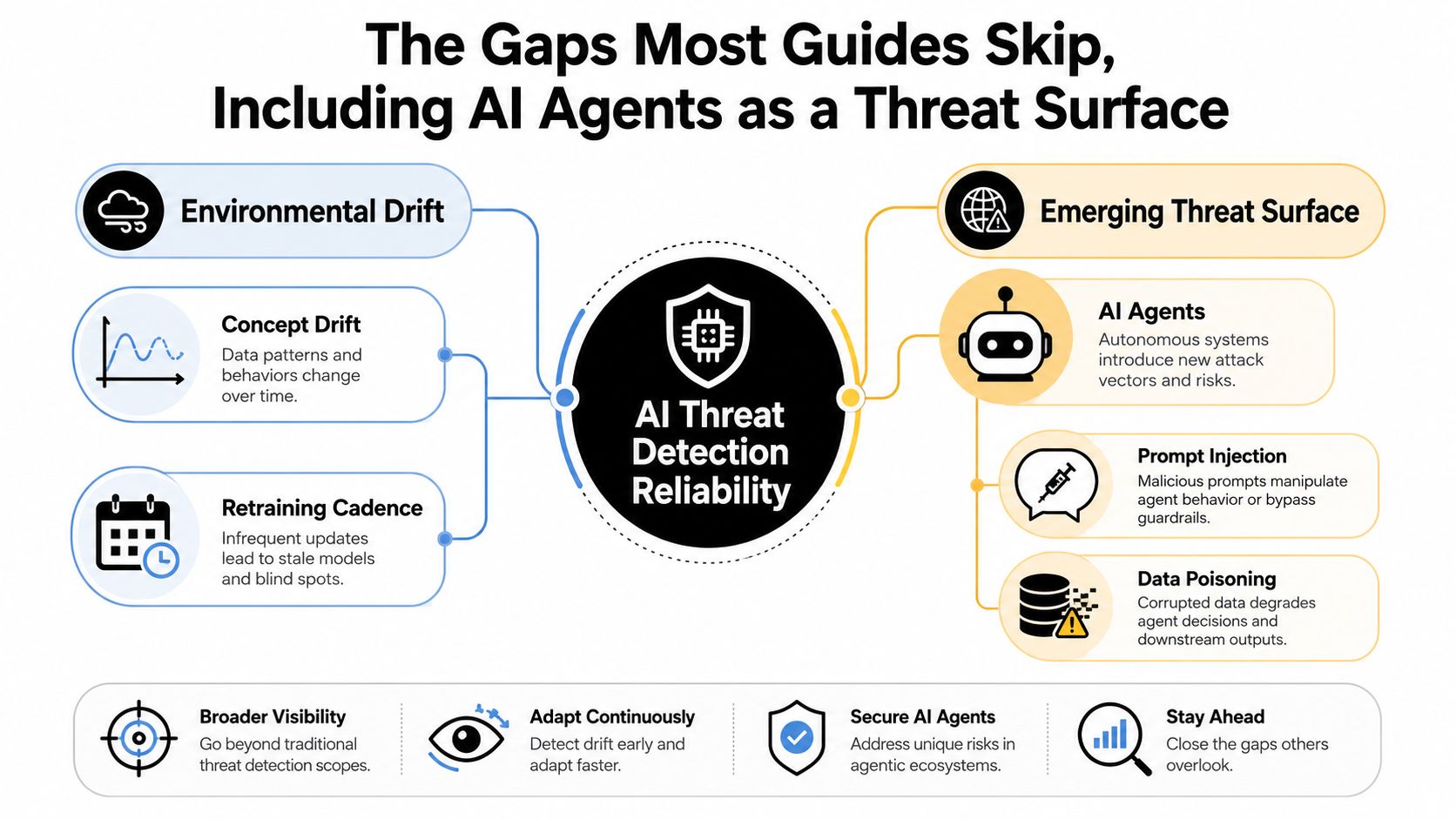
Keeping models reliable when the environment moves
The control set here is operational, not magical. Teams need continuous retraining, AI observability, and red-teaming to see when drift changes the shape of normal behavior. The challenge is that the model is learning from the environment while the environment is changing under it, so output quality can slide long before anyone notices.
That's why drift detection has to watch both inputs and outputs. If the feature distribution shifts, or the model starts producing a different pattern of scores, the SOC needs a way to tell whether the change is real risk or just an environment update. The limitation is practical, not theoretical. Current reviews still describe data quality, transparency, and performance drift as unresolved issues in AI-powered detection (Cybersecurity Institute article on AI detection shortfalls).
When identities are no longer just human
The second gap is identity. Okta's guidance notes that AI threat detection now has to cover human and non-human identities, which expands the attack surface to include service accounts, API keys, AI agents, and automated workflows (Okta AI threat detection guidance). That shift matters because machine-to-machine activity can look legitimate even when it's being abused.
The SOC has to ask different questions now. Is this agent supposed to touch that system? Is the privilege normal for this workflow? Did the sequence of actions match the expected automation path, or did it suddenly branch into something new? Risk-based correlation matters more than standalone alerts here, because one event often looks harmless until it's linked to three others.
The harder problem isn't spotting a weird login. It's spotting a malicious action that rides inside a normal automation flow.
That is where detection quality gets tested. If the system can't separate legitimate automation from abuse, the attacker gets free cover.
Implementation Checklist and Sample Detection Agent Blueprint
A useful rollout starts small. Don't try to detect everything on day one. Pick one workflow, one data source, one model, and one response path, then prove that the loop works before you widen the surface.
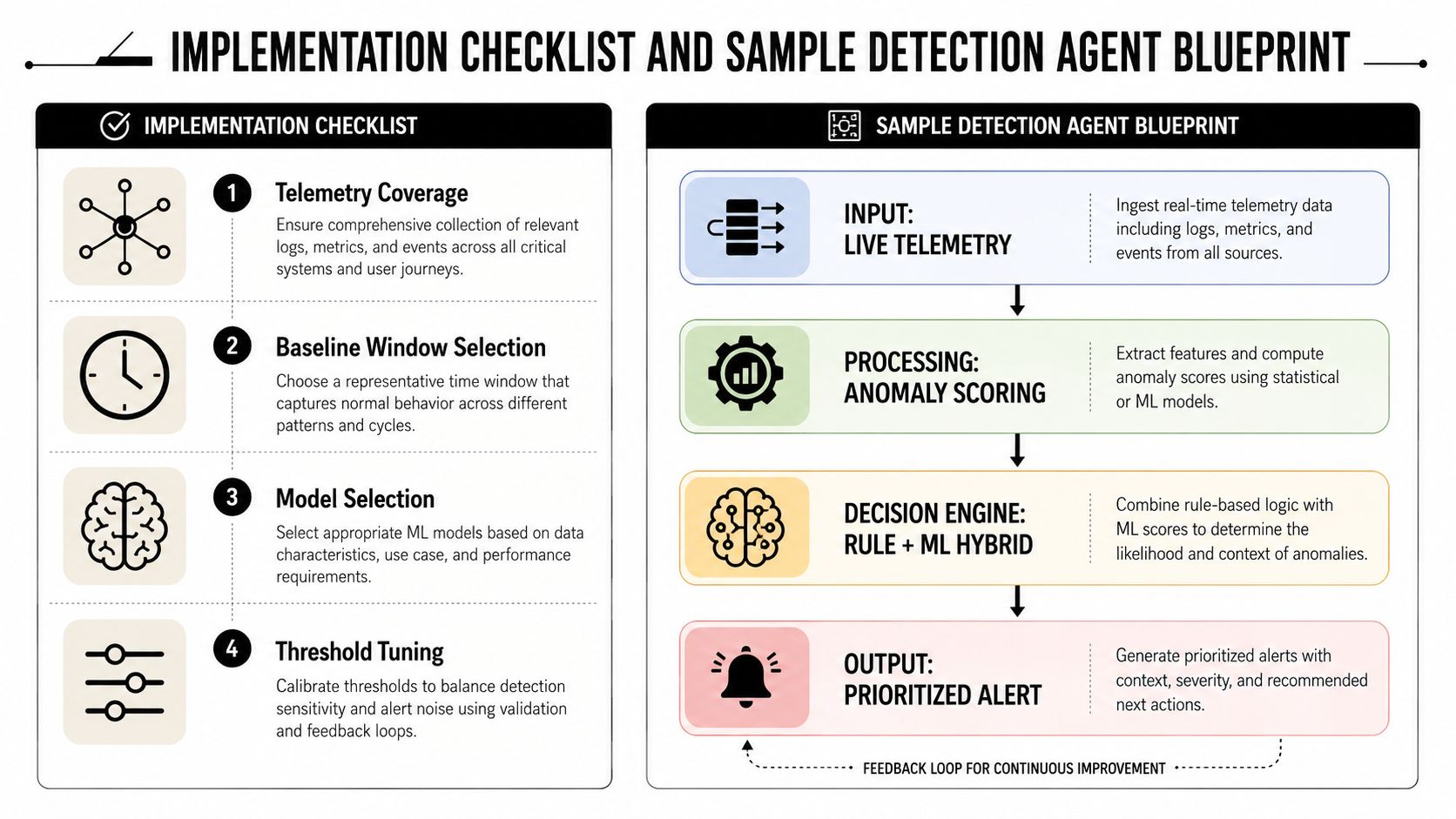
A short checklist that keeps teams honest
- Telemetry Coverage: verify that the data source sees the behavior you want to detect, including identity and endpoint signals.
- Baseline Window Selection: choose a period that reflects normal operations, not a holiday lull or an incident week.
- Model Selection: use supervised, anomaly, or behavioral methods based on the threat you're chasing.
- Threshold Tuning: set alert thresholds with analyst workload in mind, not just model score.
- Feedback Loop: capture analyst dispositions so the model can improve from real review outcomes.
A practical agent blueprint looks like this. Input comes from live telemetry and SIEM alerts. Processing enriches the event with identity, asset, and context data. Scoring combines anomaly and behavioral signals. Decision logic sends high-confidence alerts to chat or paging tools, while lower-confidence cases go to review.
That workflow becomes much easier to operate when it's packaged as a reusable agent. Inside Donely, a team can put that logic into a blueprint, run it in a dedicated instance for a client or business unit, control permissions through RBAC, and keep an audit trail for compliance. The Hermes agent page is a useful reference if you want to see how a deployable agent layer is framed in that ecosystem.
The goal is not perfect automation. The goal is to make sure the right events get enriched, scored, and routed without making the analyst do the same manual work over and over.
Bringing It Together and What to Do This Quarter
The cleanest way to think about ai threat detection is as a system, not a model. It depends on telemetry quality, training data, operational tuning, and a response path that doesn't break under pressure. It also has to handle a newer reality, AI agents and automation are part of the attack surface now, not just part of the defense.
A sensible adoption path for the next quarter is straightforward. First, instrument the telemetry and baseline the normal patterns you need to watch. Second, deploy one supervised or behavioral model with clear review metrics and a small set of response actions. Third, add drift monitoring, agent-aware identity signals, and isolation boundaries so the system stays reliable as the environment changes.
Many teams don't need to replace their SIEM to get started. They need to connect the right inputs, choose one detection problem carefully, and build a feedback loop that keeps improving. That's the point where orchestration platforms become useful, because they turn detection from a pile of scripts into something you can govern.
A CTA for Donely.