
Are you choosing an affiliate platform for its brand name, or for its real operating economics, cookie logic, and payout workflow? That question separates the sites that look good in a roundup from the best affiliate websites that make money in 2026. The affiliate market itself is still expanding, with projections pointing to $17.6 billion in 2025 and continued growth in the late 2020s, so the platform you pick affects how much of that upside you can capture (SQ Magazine affiliate marketing statistics).
For founders, agencies, and developers deploying AI agents, the practical decision is rarely “which network is biggest.” It's “which tool handles recurring commissions, attribution edge cases, payment ops, and partner acquisition without turning into a maintenance burden.” SEO still drives 69% of affiliates' top traffic sources, and 93% prioritize first-party data, which is a strong signal that durable affiliate operations need both acquisition and owned-channel infrastructure (OptinMonster affiliate marketing statistics).
The list below keeps the focus on execution, not hype. You'll see where each platform fits, what it's good at, where it's awkward, and how to think about commission structure, cookie handling, payout thresholds, and implementation trade-offs before you commit.
Table of Contents
- 1. PartnerStack
- 2. impact.com (Partnership Cloud)
- 3. Awin, including Awin Access
- 4. CJ, formerly Commission Junction
- 5. Rakuten Advertising
- 6. Partnerize
- 7. Everflow
- 8. Refersion
- 9. FirstPromoter
- 10. Rewardful
- Top 10 Affiliate Platforms Comparison
- Making Your Choice Next Steps
1. PartnerStack
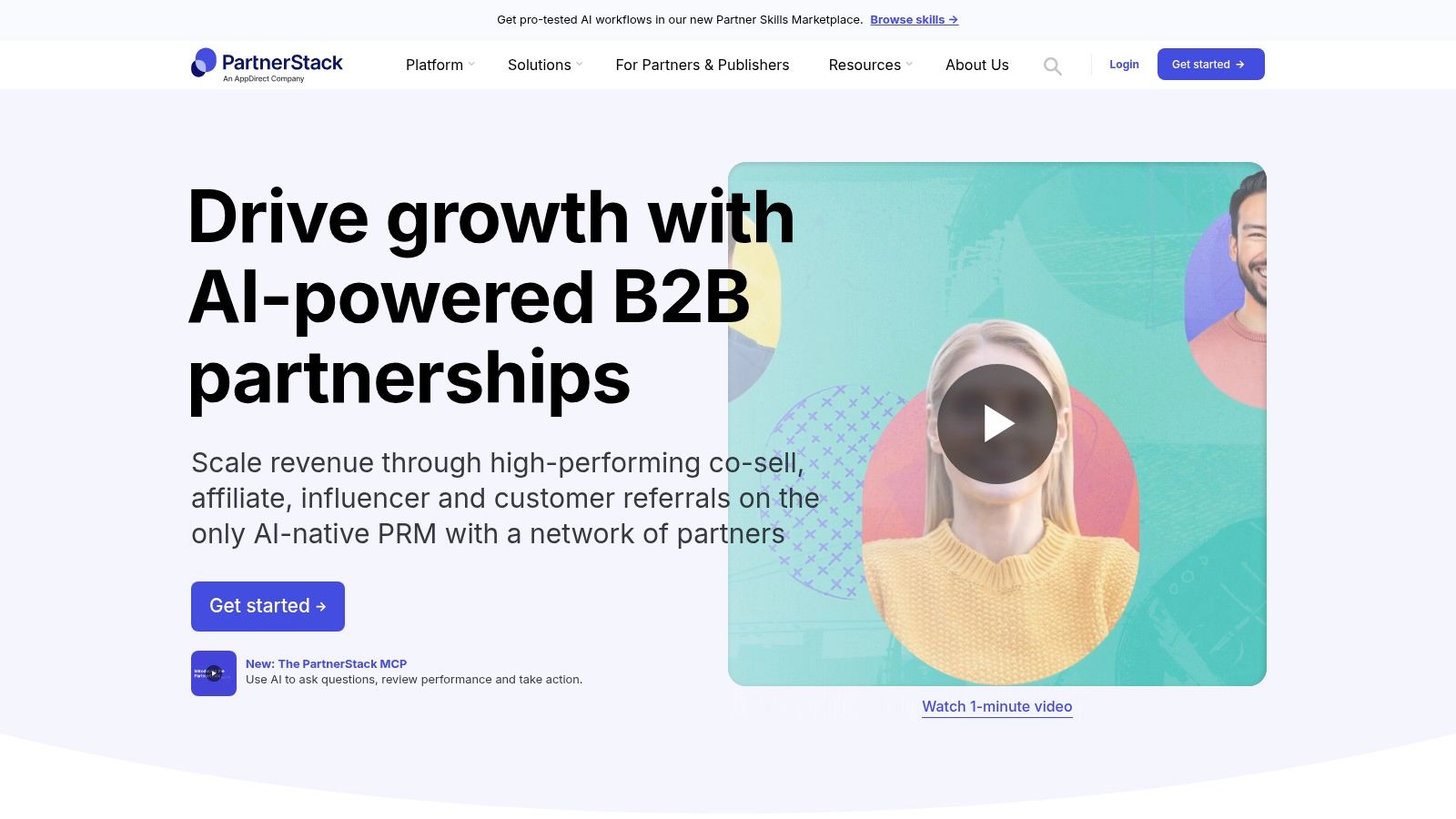
PartnerStack fits best when affiliate marketing is only one piece of a broader B2B partner motion. It brings affiliate, referral, and reseller programs into one place, so a SaaS team can recruit partners, manage attribution, and support co-sell work without stitching together separate tools. The company's own ecosystem positioning matters too, because it gives vendors a place to find partners instead of depending only on outbound recruitment through a network page like Donely's partner page.
Best fit for B2B SaaS partner ecosystems
The main trade-off is fit versus speed. PartnerStack is built for longer sales cycles, recurring revenue, and partner enablement, which is exactly what many software companies need, but it is not the fastest path if you want a lightweight launch in a few days. Budget also matters, because custom pricing and a weeks-long onboarding motion usually make sense only when the expected partner value is meaningful.
Practical rule: Use PartnerStack when you need partner acquisition, onboarding, payout administration, and pipeline visibility in one operational layer.
For commission structure, the strongest use case is recurring SaaS compensation tied to subscription revenue. Cookie duration matters less here than attribution quality across trial, conversion, and expansion events, because the value is in tracking partner influence over a long customer lifecycle. If you are running AI agents for program ops, this is a good place to automate partner status checks, lead routing, payout monitoring, and integration handoffs through Donely integrations and performance monitoring workflows.
A clean implementation usually starts with one offer, one partner persona, and one payout policy. Launching every program type at once creates more cleanup later. PartnerStack works best when the team can support a defined partner motion and wants a system that behaves more like a revenue channel than a simple link tracker.
2. impact.com (Partnership Cloud)
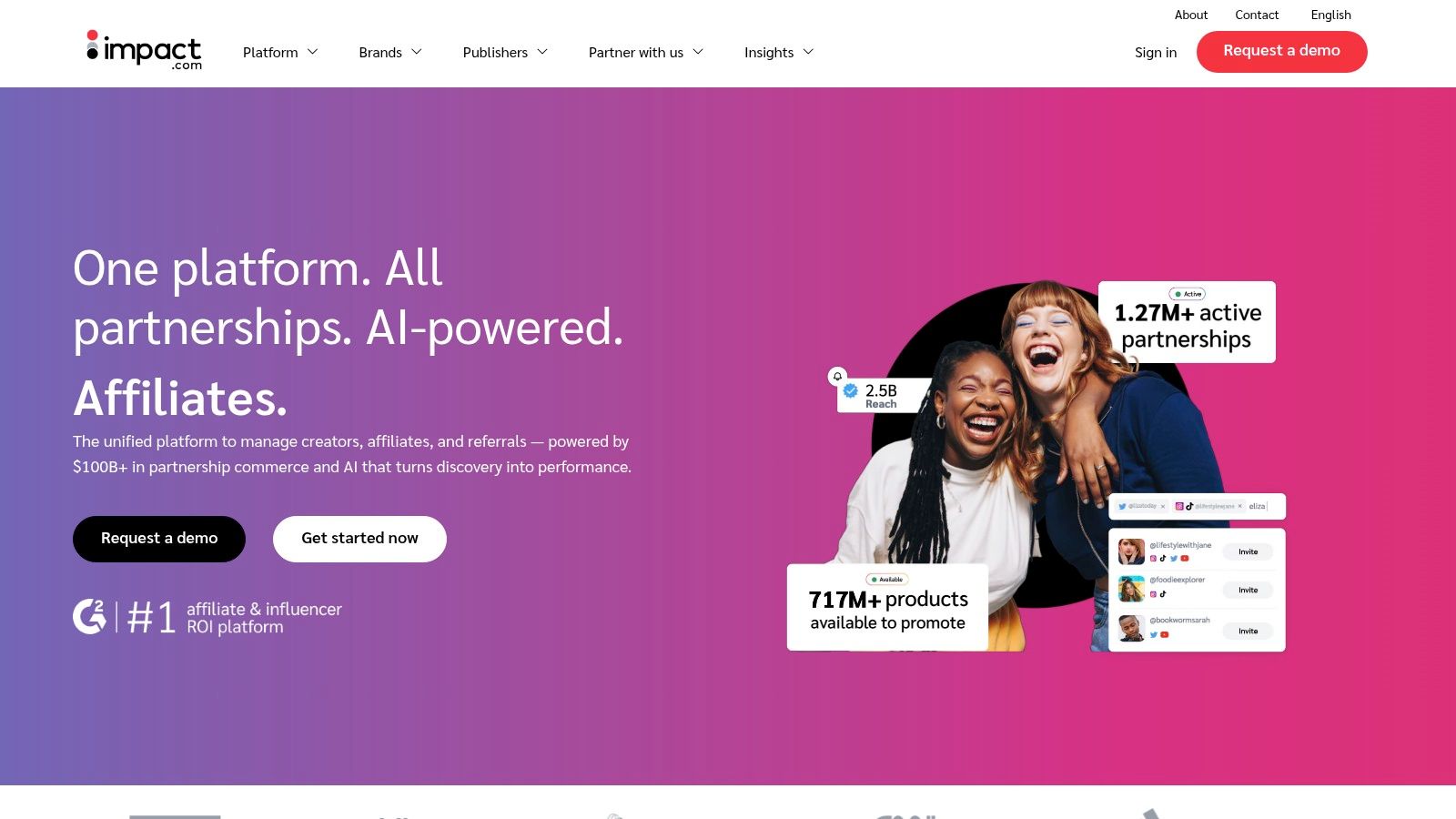
impact.com is the platform I'd choose when an affiliate program has outgrown simple tracking. It covers affiliates, creators, influencers, and B2B partnerships, so teams can keep discovery, contracts, and payouts under one operating layer. Smaller teams can start with its Starter option, then move into enterprise workflows as the program becomes more complex.
Best fit for teams that need partner ops and payments in one place
The financial operations layer is the main advantage. Global payment handling, tax logic, currency conversion, and multiple payout methods are built into the workflow, which reduces time spent reconciling vendor-by-vendor payment issues. That matters more than a polished commission table when partners are spread across regions and expect reliable settlement.
The trade-off is setup complexity. impact.com can handle a lot, but that breadth means more configuration choices, and the higher tiers usually involve a sales process. If you only need a simple referral engine, it may feel heavier than necessary.
Teams that expect mixed partner types should define payout rules before program launch, not after the first invoice cycle.
For AI-enabled operations, impact.com is a strong candidate if you want agents to watch for contract status changes, payment exceptions, or partner approvals and then trigger alerts or internal tasks. If your program depends on external systems, the platform's integrations and APIs become part of the value, not an extra. Used well, it gives you a centralized place to coordinate the commercial side of a multi-channel partnership program instead of scattering it across spreadsheets and inboxes.
A good way to pressure-test the platform is to compare its operating overhead with your current stack. If you are mapping commission rules, payout thresholds, and partner workflows against other options, Donely's pricing page is a useful reference point for judging whether you need a broader platform or a lighter setup.
3. Awin, including Awin Access
Awin is a strong choice when the main problem is access. Its network gives brands a broad publisher pool, and its plan structure, including Awin Access, helps smaller teams get moving without guessing at every commercial term. For merchants that need reach fast, that self-serve onramp is often more valuable than chasing a highly customized setup.
Best fit for fast starts and broad publisher reach
Awin's model works best for commerce-heavy programs. The network is built around transaction-based affiliate activity, so it's a natural fit for retailers and brands with clear order values, straightforward conversion events, and a need for breadth across publisher types. That also explains one of its limitations, SaaS programs without classic order value may need a different pricing or attribution fit.
The strongest operational advantage is budget clarity. When a platform uses a clearer plan structure, it becomes easier to forecast total platform cost, especially for teams that hate variable surprises. The trade-off is that more advanced automation and custom reporting tend to sit higher up the plan ladder.
If your program is new, use the simplest plan that gives you enough visibility to verify traffic quality and commission accuracy.
Awin is also relevant when you care about partner discovery more than network novelty. Broad reach can help, but only if your creative, tracking, and landing pages are ready. Teams that bring in an AI workflow should focus on partner review, coupon abuse checks, and escalation handling, because wide network access is only useful when ops can keep the program clean.
4. CJ, formerly Commission Junction
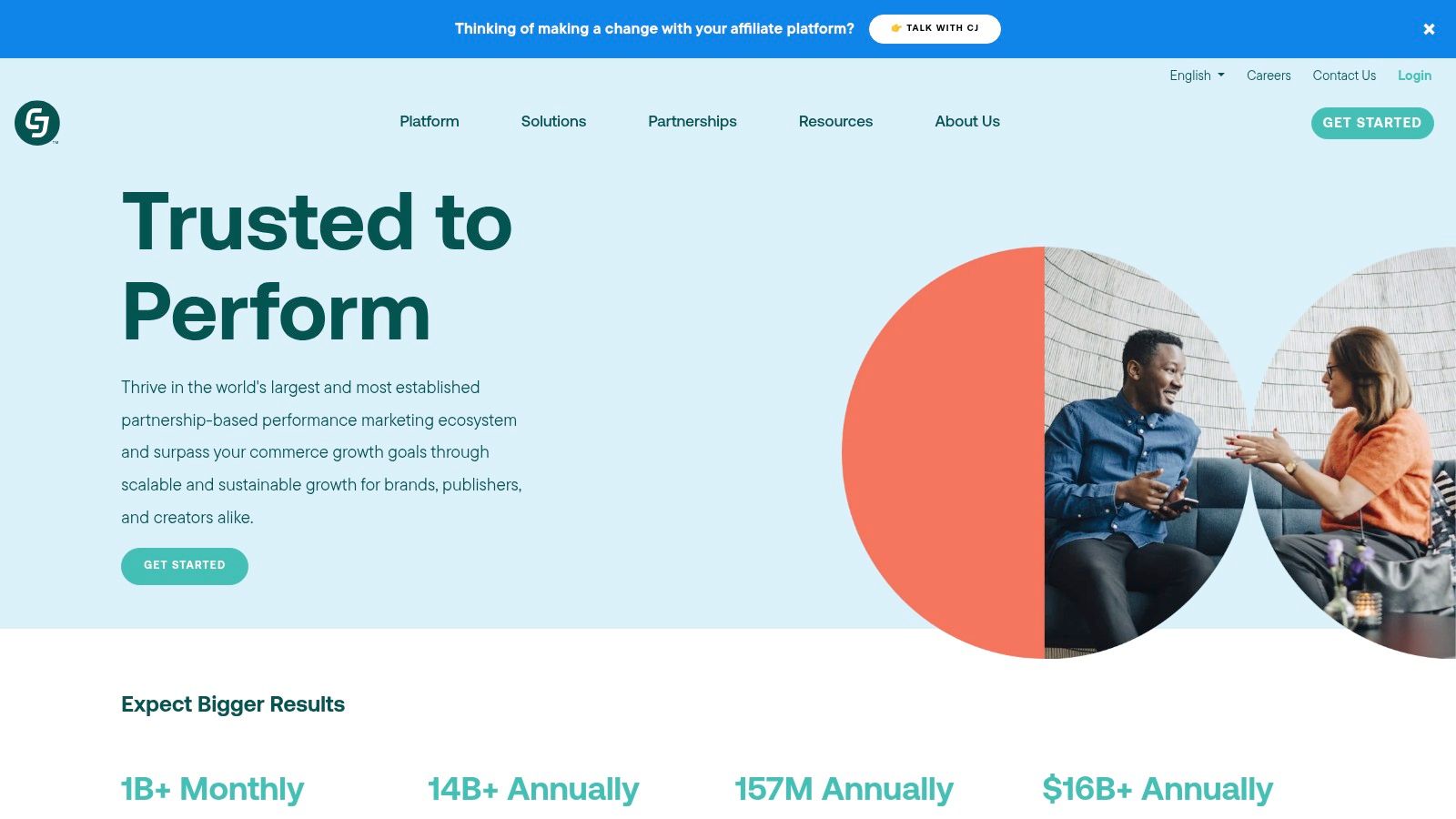
CJ is one of the most established affiliate networks in the U.S., and that longevity shows up in the way it handles scale, recruitment, and conversion complexity. It's a good fit when you want curated partners and stronger data controls instead of a lightweight self-serve setup. For brands that care about premium publisher relationships, that matters.
Best fit for premium publishers and complex conversion tracking
The standout feature here is conversion breadth. CJ supports pay-per-call tracking, which is useful for businesses where phone leads still matter, not just click-to-purchase paths. It also offers a placements marketplace, which gives advertisers another way to manage paid placements and partner visibility.
That said, CJ can feel enterprise-heavy. Pricing isn't publicly listed, migrations usually involve CJ support, and the platform expects a team that can handle more structured onboarding. If your affiliate program is tiny, the overhead may outweigh the benefits.
For commission design, CJ works best when the merchant already knows how to segment partners by value, not just by volume. Paid placements, premium publishers, and performance-driven partner management all benefit from tighter program governance. If you're deploying AI agents around the platform, keep them focused on partner screening, placement tracking, and exception alerts, because those are the places where a mature network can still create manual drag.
CJ suits operators who want a deep network and don't mind an implementation process. If your goal is to recruit at scale while keeping attribution flexible, it's still one of the more credible options on the list.
5. Rakuten Advertising
Rakuten Advertising is the network I associate with control. It leans hard into compliance, partner discovery, and managed services, so it suits brands that want a tighter operating framework around their affiliate activity. That approach can feel conservative, but it helps when brand safety is a top priority.
Best fit for controlled growth and brand safety
The platform's managed services model is the part that changes the conversation. Forecasting and cost-of-sale style bundling can simplify planning for teams that want clearer commercial expectations, especially when the business is trying to avoid a messy open-ended rollout. Rakuten's analytics and personalization features also help programs tune partner interactions more carefully.
The trade-off is that it's not a casual self-serve toy. Pricing isn't public, the process is more enterprise-oriented, and network policies can be strict for certain verticals. Those constraints can frustrate teams that want speed over process, but they also keep the network cleaner than looser alternatives.
For coupon-heavy or brand-sensitive programs, that rigor is often a feature. It reduces the odds of partner behavior that can distort attribution or create user-experience issues. If your AI agents are handling compliance checks or partner communication workflows, Rakuten is one of the better environments for structured automation because the rules are defined and the program logic is explicit.
6. Partnerize

Partnerize is for teams that already know affiliate marketing is no longer just a referral link problem. It's a partner marketing platform with discovery, commissioning, fraud protection, and flexible pricing, which makes it appealing to companies operating across multiple markets or channels. That broader scope is exactly why it's powerful.
Best fit for high-volume, multi-region programs
The main strength is commissioning control. Dynamic commission logic lets teams adapt incentives to different partners, regions, or products without rebuilding the program from scratch. That's valuable when a business has mixed partner value or needs to manage multiple incentives inside one system.
The platform also takes governance seriously. Brand safety and fraud prevention help protect programs that would otherwise get noisy as volume rises. The downside is implementation effort, because the platform delivers most of its value once the team designs the program thoughtfully.
Budget for setup, not just software. Partnerize makes more sense when the business can support onboarding, policy design, and ongoing optimization.
This is not the best first platform for a solo founder testing a few links. It is a better fit for high-growth brands, agencies with demanding clients, and enterprise teams that need repeatable controls across regions. In AI-heavy environments, Partnerize can support automated alerting on fraud signals, commission exceptions, or workflow bottlenecks, which makes it easier to run a program without constant manual review.
7. Everflow
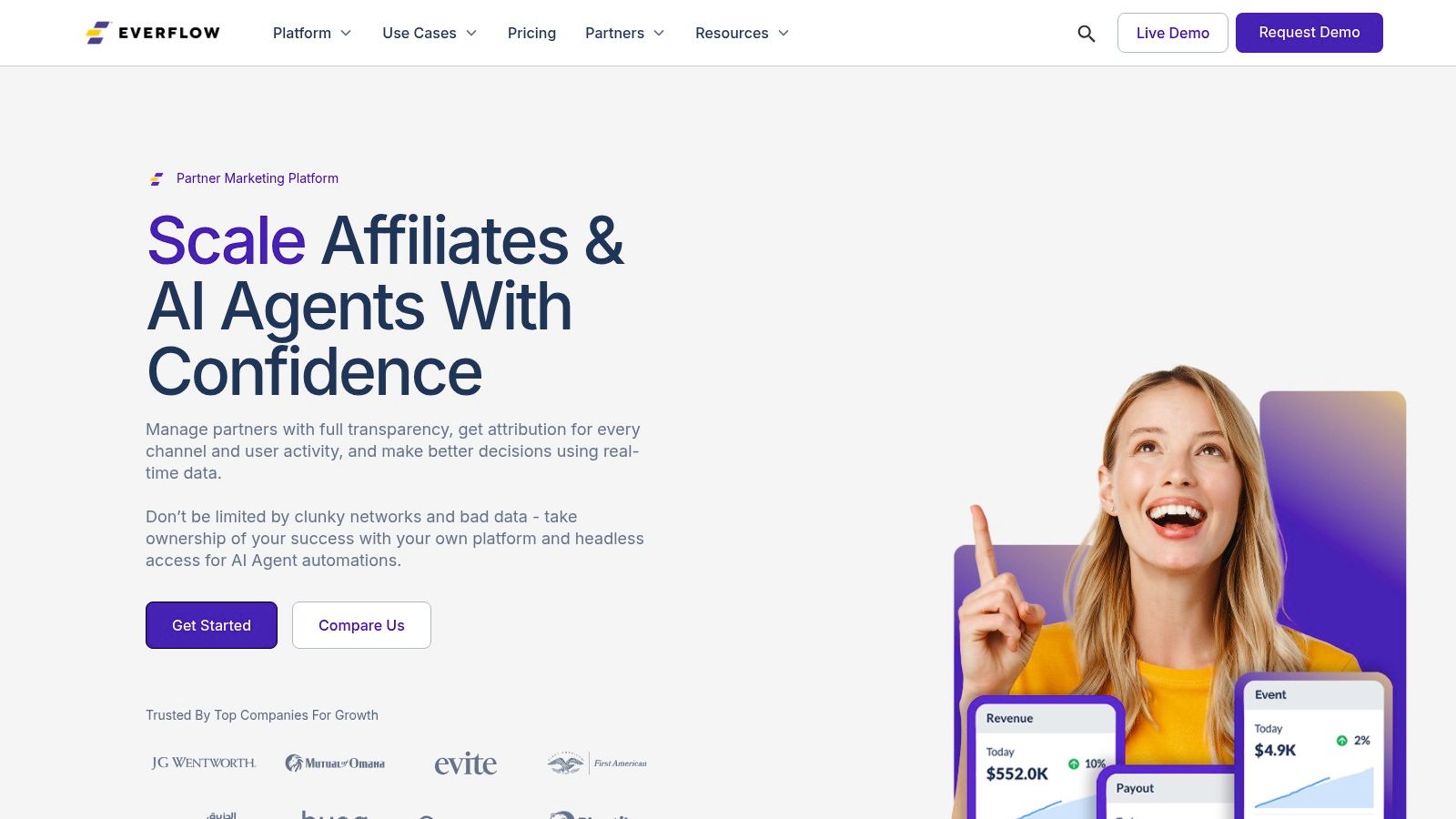
Everflow is the platform for teams that want one control layer across affiliates, influencers, referrals, and paid media. Its appeal is not just tracking, it's the ability to centralize multiple acquisition channels in one UI and still keep the partner side usable. Agencies tend to like that kind of flexibility.
Best fit for brands and agencies that need flexible tracking
The payment side is unusually practical. Everflow Pay supports ACH, wire, PayPal, Payoneer, Wise, and more, which gives operations teams more room to match payout method to partner preference. That can reduce manual back-and-forth and make settlement easier across different geographies.
The trade-off is setup. Everflow is powerful, but it doesn't hide its complexity, and teams usually need time to learn the reporting stack well enough to trust it. That makes it a strong fit for operators who care about data architecture and not just campaign launch speed.
If you're building AI agents around an affiliate workflow, Everflow is attractive because the platform already thinks in terms of data centralization. Agents can monitor partner types, status changes, and payout operations, then surface anomalies before they become support tickets. For agencies, that kind of control can make the difference between a scalable service and a pile of disconnected client dashboards.
8. Refersion
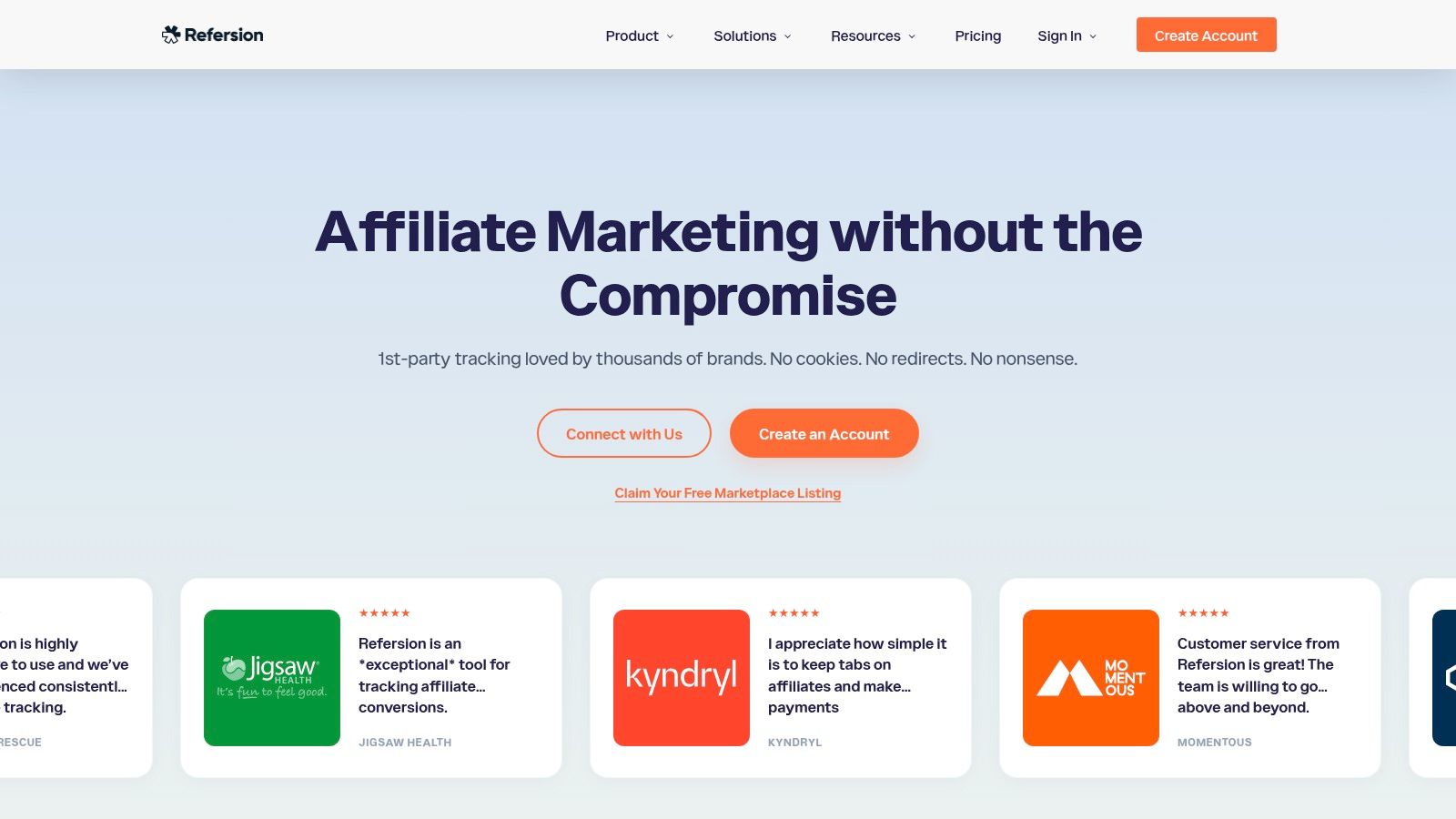
Refersion has a straightforward appeal. It's built for eCommerce teams that want to recruit, track, and pay affiliates and influencers without building a custom system from scratch. If your stack is Shopify or Shopify Plus heavy, that store-centric orientation is a real advantage.
Best fit for eCommerce teams that want a store-centric setup
The operational benefit here is speed. Refersion's dashboard approach is simple enough for small marketing teams to learn quickly, and the GraphQL API gives developers a path to custom pulls or storefront-specific logic. That combination is useful when you want low-friction onboarding but still need integration flexibility.
Where it's less compelling is complex SaaS attribution. Subscription businesses with nuanced MRR changes, upgrades, or churn-driven commission rules usually need a tool that was built more directly around billing edge cases. Refersion can still work in mixed cases, but it's not as specialized there.
For commission structure, this is a better fit when you're paying on purchases or straightforward sales events rather than layered recurring compensation. The platform's value rises when the store team wants a manageable workflow, not when the program needs elaborate partner segmentation. AI agents can help here by flagging underperforming affiliates, watching payout queues, and syncing status changes across the store stack.
9. FirstPromoter
FirstPromoter is one of the cleanest answers for subscription SaaS teams that live inside Stripe. It handles recurring commissions, tiered logic, lifetime commissions, and the messy attribution details that show up when customers upgrade, downgrade, or churn. That makes it useful for products where subscription movement matters as much as the initial referral.
Best fit for subscription SaaS with Stripe billing
The biggest advantage is billing-native logic. Coupon-code attribution, Stripe integration, and recurring commission support reduce the amount of custom glue code a team needs to maintain. That matters because affiliate tools fail most often in the edge cases, not on the first conversion.
The downside is discovery. FirstPromoter is a tracking and payout layer, not a marketplace. You still need to recruit partners yourself, which means the platform solves program mechanics, not partner acquisition. It also means cookie limitations can become a practical issue if you don't use code-based routing and clean attribution practices.
For SaaS, the best setup is often a hybrid one, links for discovery, coupons for reliable attribution, and strong internal logging for revenue events.
If you're deploying AI agents, FirstPromoter is a good place to automate support around commission explanations, subscription-event monitoring, and payout reminders. It's not flashy, but it's dependable. For SaaS founders who value recurring commissions over one-time consumer sales, that's often the right trade.
10. Rewardful
Rewardful is the simplest tool on this list that still feels serious for SaaS. It's Stripe-centric, lightweight, and quick to implement, which makes it attractive when you want to test an affiliate program without committing to a heavier operational stack. Early-stage teams often need exactly that.
Best fit for early-stage SaaS programs
The platform's strongest feature is ease of launch. Link tracking, coupon mapping, and mass payouts via PayPal and Wise give a startup enough machinery to run a real program without building a custom finance workflow. That's especially useful when the team is still figuring out whether affiliate traffic will convert at all.
Its limitation is obvious. There's no built-in discovery marketplace, and the feature set is intentionally lean, so it won't replace enterprise-grade partnership infrastructure. That's fine if you want a testable system, less fine if you need layered partner management.
For commission structure, Rewardful is best when you're testing recurring SaaS commissions and want to keep implementation simple. It's also one of the more developer-friendly ways to pilot a referral motion, because the surface area is small enough to manage cleanly. If AI agents are part of the workflow, the most useful automations are status checks, payout coordination, and alerting on failed attribution or missing customer metadata.
Top 10 Affiliate Platforms Comparison
| Platform | Core features / Capabilities | UX / Quality (★) | Price / Value (💰) | Target (👥) | Unique selling point (✨ / 🏆) |
|---|---|---|---|---|---|
| PartnerStack | Marketplace (115k+ partners), onboarding, payouts, affiliate/referral/reseller support | ★★★★, discovery-focused; onboarding in weeks | 💰 Custom / higher; ROI for budgeted teams | 👥 B2B SaaS vendors, mid-enterprise | ✨ Marketplace-driven partner acquisition · 🏆 Partner discovery channel |
| impact.com (Partnership Cloud) | End-to-end lifecycle, global payouts, contracts, APIs, marketplace | ★★★★, highly scalable; strong finance ops | 💰 Starter→Enterprise; enterprise via sales | 👥 Brands, creators, enterprises | ✨ Global payments + automated payouts · 🏆 Financial ops at scale |
| Awin (incl. Access) | 1M+ publishers, tiered plans (Access→Advanced), transaction fees | ★★★★, fast SMB onramp | 💰 Plan-based; Access = self-serve | 👥 eCommerce & global publishers, SMBs | ✨ Massive publisher reach · 🏆 Fixed plan simplicity |
| CJ (Commission Junction) | Curated publishers, Pay‑Per‑Call, placements marketplace, attribution | ★★★★, premium network & insights | 💰 Consultation / enterprise pricing | 👥 Brands seeking premium publishers & scale | ✨ Advanced attribution & placements · 🏆 Longstanding high-quality network |
| Rakuten Advertising | Partner discovery, compliance, Affiliate Intelligence, managed services | ★★★★, brand-safe, compliance-first | 💰 Enterprise quotes; managed cost‑of‑sale options | 👥 Brands needing compliance & controlled growth | ✨ Rigorous compliance & forecasting · 🏆 Brand-safety posture |
| Partnerize | End-to-end partner management, dynamic commissioning, fraud prevention | ★★★★, enterprise-grade, implementation effort | 💰 Consultative pricing (license or performance) | 👥 Multi-region, high-volume brands | ✨ Fraud & governance controls · 🏆 Flexible pricing models |
| Everflow | White‑label tracking, unified reporting, Everflow Pay (many payout methods) | ★★★★, robust reporting; setup required | 💰 Quote-based; scalable | 👥 Brands, networks, agencies | ✨ White‑label + multi‑payout operations · 🏆 Centralized partner data |
| Refersion | Affiliate/influencer tracking, GraphQL API, store-centric integrations | ★★★, fast Shopify-centric launch | 💰 Affordable; scales with affiliate sales | 👥 eCommerce stores (Shopify/Shopify Plus) | ✨ Quick store integrations & API access |
| FirstPromoter | Native Stripe, recurring/tiered commissions, coupon attribution for MRR | ★★★★, SaaS-focused; quick time-to-live | 💰 Competitive SaaS pricing | 👥 SaaS startups on Stripe | ✨ Subscription MRR attribution · 🏆 Purpose-built for SaaS billing |
| Rewardful | Stripe-native tracking, coupon/link attribution, mass payouts | ★★★, lightweight & easy to implement | 💰 Low-cost; ideal for early-stage testing | 👥 Early-stage SaaS testing affiliates | ✨ Minimal setup for testing · 💰 Cost-effective entry point |
Making Your Choice Next Steps
The choice among the best affiliate websites comes down to operating model, not brand familiarity. If you need a partner marketplace and SaaS partner motions, PartnerStack is hard to ignore. If you want broader lifecycle management and payment infrastructure, impact.com and Partnerize are stronger. If you need broad network access, Awin, CJ, and Rakuten Advertising deserve attention. If you're running an eCommerce store, Refersion is more natural, and if your business is Stripe-based SaaS, FirstPromoter or Rewardful will usually be easier to live with.
Commission structure should be the first filter. Recurring SaaS commissions demand different tooling than one-off retail sales, and the wrong platform creates hidden work in attribution, finance, and partner support. Cookie duration matters too, but only after you've confirmed the platform can track the conversion path you care about, whether that's a click, a lead, a coupon redemption, or a renewal event.
Payout thresholds and payout methods also change the economics more than many teams expect. A platform can look inexpensive until finance starts dealing with manual reconciliation, currency conversion, or exception handling across partners. The best implementations are the ones that make payment rules boring, predictable, and easy for partners to understand.
For founders and agencies building with AI agents, the goal is not just to automate reporting. It's to remove the repetitive work around partner onboarding, performance checks, payout alerts, and data syncs so your team can focus on program design and partner quality. That's where a centralized automation layer becomes valuable, especially if you're running multiple affiliate programs or client accounts at once.
If you're choosing a platform this quarter, start with one narrow pilot, one clean commission rule, and one reporting cadence. Then expand only after you've verified that tracking, payouts, and partner behavior line up with how your business sells.
Donely helps teams automate the operational side of affiliate and partner programs without adding DevOps overhead. If you're managing multiple programs, client workspaces, or AI-driven workflows, visit Donely to deploy isolated agents, connect your tools, and keep reporting, monitoring, and billing in one place.